

How South Africa's largest retail credit provider used Intuition to take control of credit strategy, improve risk selection and support more than 10 million applications without reported downtime.
“Our main objective was to take control into the analytical team and reduce the time to make changes. That objective has been ticked 100%, and more.”
- 115 policy changes deployed since go-live
- 48 hour average turnaround on a policy change
- 10m+ applications processed
Client context
Tenacity is the financial-services business operating within the Pepkor environment, providing store-card credit across brands including PEP, Ackermans and Pepkor's specialty retailers. It serves roughly 4 to 4.5 million customers, and roughly one in three store cards in South Africa is a Tenacity card. This is a mass-market, lower-LSM business, where the market is large but margins are thin. Unlike businesses that can offset credit risk with product margin, Tenacity's credit decisioning has to be disciplined by design. At this scale, even small improvements in policy precision translate into meaningful outcomes across the book.
The challenge
Tenacity's growth was outpacing the systems supporting it. The existing technology environment was struggling to keep up with rising application volumes. Introducing a new credit policy typically required coordination across analysts, business stakeholders, developers and release teams, and a single change could take up to two sprints, or around a month, even when prioritised. Because granular rule changes were costly to build, Tenacity sometimes had to apply broad risk and fraud rules rather than targeted ones. That forced broader controls and cost the business the precision it needed.
The implementation approach
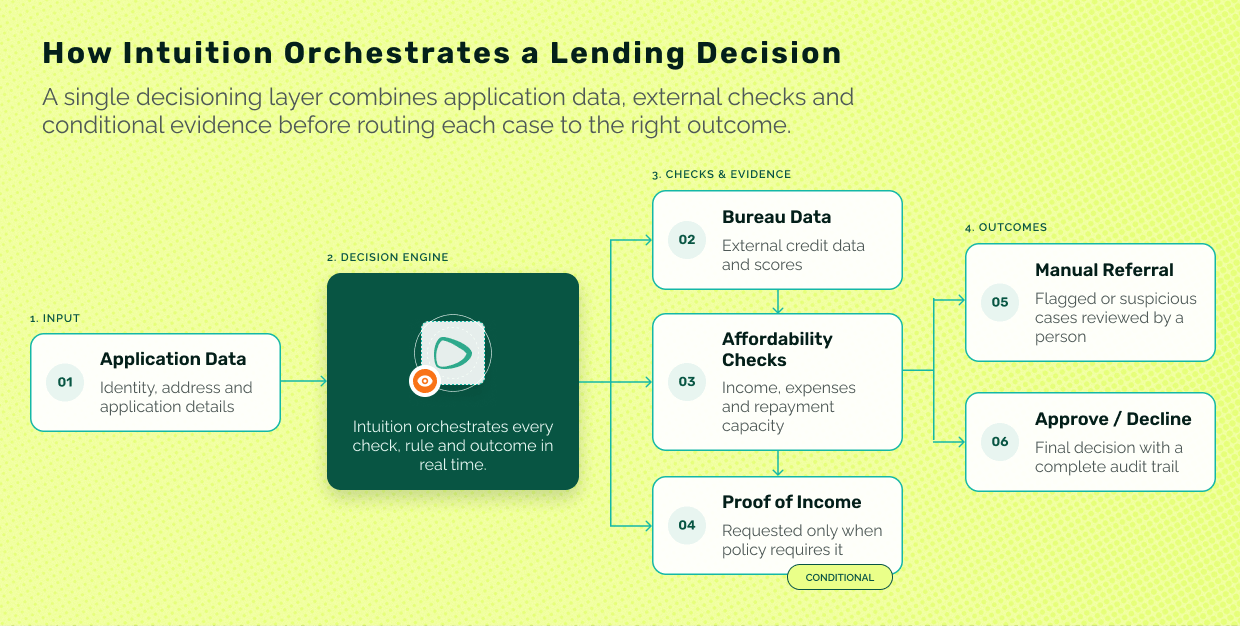
Tenacity worked with Ingenuous to deploy Intuition as a real-time decisioning workflow for store card onboarding, built around four stages:
1. Initial capture & pre-screening
Applicants submit core identity and address details, triggering eligibility checks such as age validation and blacklist screening.
2. Bureau-enriched risk assessment
Intuition integrates with TransUnion to retrieve credit bureau data, then applies scorecards and risk rules to assess creditworthiness.
3. Affordability & verification
Income and expense details are captured and assessed for affordability. Conditional requirements, such as proof of income, may be triggered depending on employment type or risk indicators.
4. Final decisioning
Intuition returns an approve or decline outcome, with potential fraud indicators routed to manual review.
There's a wider lesson here for anyone modernising this kind of infrastructure. Tenacity changed the technology first and only adjusted its risk appetite once the platform had proven stable.
Results
Policy agility
Where policy changes once took up to a month, Tenacity now averages a 48-hour turnaround. Since going fully live, the team has made 115 policy changes, with roughly 90% handled entirely by Tenacity's own analytics team, without direct Ingenuous involvement. This has reduced the need for ongoing vendor support and lets the business react far faster to changing market conditions.
A different operating model
The shift is organisational as much as technical. Before Intuition, introducing a new credit policy usually meant coordinating across analysts, business stakeholders, developers and release teams, and every handover added time to the process. Today most changes are managed directly by Tenacity's own analytics team. The analysts who spot a risk issue are the same people who put the fix live, which allows Tenacity to respond to changing market conditions in days rather than weeks.
More precise risk selection
Previously, adjusting risk meant opening or closing an entire risk band, a blunt lever that affected everyone inside it. With Intuition, Tenacity can split a band into smaller populations and treat each one on its own merits. A lower risk group that would previously have been declined can now be approved, while a higher risk group inside the same band can be excluded. Of everything the platform has changed, this is the result Tenacity values most, because it improved the quality of the decisions being made.
Operational efficiency
Before Intuition, introducing a new credit policy often required coordination across analysts, business stakeholders, developers and release teams. Today, most policy changes are managed directly by Tenacity's own analytics team, which lets them respond to changing market conditions in days rather than weeks. What was once a multi-team dependency is now a capability the business controls itself.
Change management that once involved four or five people across multiple teams now runs with one or two core operators. Twelve people previously working in document vetting have been redeployed into a new fraud and referral function. More precise upfront declines have also helped Tenacity avoid an estimated 10% of bureau enquiries, around 700,000 over twelve months.
Scale and resilience
Intuition has supported more than 10 million applications and approximately 7 million bureau enquiries, with 0% downtime reported over the period. That stability has given Tenacity the confidence to reprioritise its wider technology roadmap as business needs shifted.
"We have two people running Intuition, and changes can move through analysis, testing and deployment within 24 to 48 hours."
Give your credit and risk teams control of decisioning
See how Intuition for Lending works | Discuss your credit decisioning strategy
Frequently asked questions
How quickly can credit policies be changed in Intuition?
Turnaround depends on the complexity of the change, but Tenacity's experience shows policy changes moving from analysis through to deployment in as little as 24 to 48 hours, compared with weeks under a traditional development cycle.
Can credit teams configure policies without developers?
Yes. Intuition is designed so that credit and risk teams can build, test and deploy most policy changes themselves, which reduces the dependency on development resources for day to day adjustments.
How does Intuition support store-card onboarding?
Intuition manages the full onboarding journey in real time, from the first eligibility check through to the final approve-or-decline decision, with bureau and affordability checks along the way.
Can Intuition combine credit and fraud decisions?
Yes. Intuition handles credit risk and fraud detection within a single decisioning workflow, and the rules for each can be configured and deployed independently as new patterns emerge.
How does Intuition reduce bureau costs?
By enabling more precise upfront eligibility and risk rules, Intuition can decline unsuitable applications before they reach the bureau stage, which avoids unnecessary enquiry costs.
Can Intuition support high volume retail lending?
Yes. Intuition has supported implementations processing more than 10 million applications, with high availability reported at that scale.